Wolf messages and the verification of the caribou’s location
Never Cry WolfA sequence of distant calls becomes, for Ootek, information that can be acted upon: first a report of moving Caribou, then news of people crossing a neighboring territory. The narrator cannot hear the sounds that Ootek interprets, and initially treats the first account as an implausible story. Mike’s return with game from the predicted location gives the claim a concrete test, while a later arrival of visitors supplies a second, distinct confirmation. The episodes do not make the narrator an independent interpreter of wolf speech; instead, they show how observation, local knowledge, and practical outcomes complicate his skepticism.
Listening at the observation tent
A few days after Ootek joined the narrator at the observation tent, the two had spent hours watching the den without seeing anything notable. The day was still, the flies were thick, and Angeline and the pups had withdrawn into the den while George and Uncle Albert rested nearby after a hunt. The narrator was becoming drowsy when Ootek suddenly cupped his hands to his ears and listened toward a range of hills about five miles to the north. He told the narrator that the wolves were talking, though the narrator heard only mosquitoes.
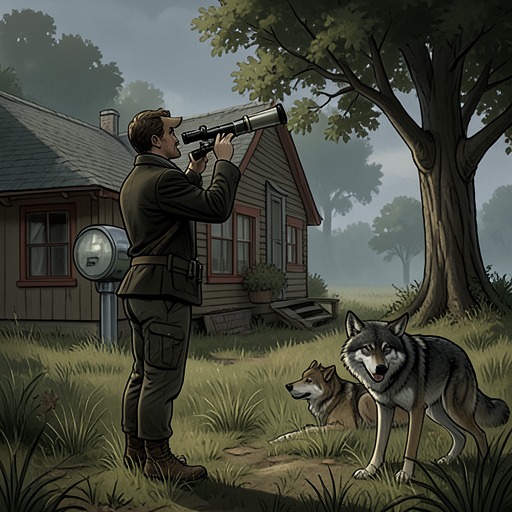
George’s response was observable even though the source of his attention was not. The resting male sat up, directed his ears north, and after a minute or two raised his muzzle to howl. His long, wavering call climbed from a low note to the highest pitch the narrator could hear. Ootek reacted with delight and interpreted the exchange as a message that Caribou were coming. The difference between the two men’s access to the event is central: the narrator records George’s posture and howl directly, but the content of the supposed message reaches him through Ootek.
Ootek later explained the call as a report relayed across territories. A wolf to the north, he said, had informed the local Wolves that the Caribou had begun moving south and had indicated where they were. That wolf had not necessarily seen the herd himself; he was passing on information from a more distant wolf. George, having heard and understood the report, then passed the news onward. The account therefore described not just a sound between nearby animals but a chain of communication carrying information beyond the narrator’s range of hearing.
The journey to Kooiak
The narrator was skeptical, but Mike treated Ootek’s interpretation as sufficient reason to travel. He began packing for a hunting trip, despite the prospect of a two- or three-day walk across the tundra. The narrator understood why Mike wanted to find Caribou: people in the region depended heavily on them for meat when they were available. What astonished him was Mike’s willingness to set out on the strength of a message he could not verify for himself. Mike offered no further explanation; he left without another word.
Three days later, Mike returned with a haunch of venison and a pot of Caribou tongues. He said he had found the herd exactly where Ootek had indicated: on the shores of Kooiak, a lake about forty miles northeast of the cabin. This outcome gave the account a practical consequence that the narrator could not dismiss as merely a description of wolf behavior. The message had directed a human journey, and the journey had reached the reported location.
Even then, the narrator told himself that the result had to be coincidence. His response preserves the gap between a successful prediction and full acceptance of Ootek’s explanation: reaching the lake confirmed the location, but the narrator still resisted treating the wolves’ communication as established fact. He feigned a change of mind and asked Mike to explain Ootek’s supposed ability. Mike maintained that wolves could communicate over long distances and that some people, particularly Ootek, could hear and understand them well enough to converse with them. The narrator presents this as Mike’s account, not as a capacity he had personally acquired.
A second report: visitors on the tundra
A later episode extended the claim from animal movements to human travel. On another occasion, George again appeared on the crest and turned his ears north. This time he did not howl; after listening, he went to the den and greeted Angeline. The narrator saw no clear sign of what George might have heard, but Ootek became visibly excited and tried to make himself understood. He repeated words for people and for coming, then set off northwest across the tundra, in the direction of Mike’s cabin.
Ootek’s departure initially seemed abrupt to the narrator. Its purpose became clearer when Ootek returned with three friends, all of whom were shy at their first meeting with the narrator. At the cabin, Mike confirmed that Ootek had known the men were on their way. Ootek’s explanation, as Mike relayed it, was that a wolf on the Five Mile Hills had reported the travelers passing through its territory. When Ootek could not make the narrator understand the warning, he had gone to meet his friends himself.
The second episode differs from the journey to Kooiak. The first involved a long expedition and a specific reported location, followed by Mike’s return with food. The later report led instead to Ootek’s departure and reunion with people whose arrival the narrator then witnessed. Together, the episodes present wolf messages as useful information within Ootek’s account of the landscape, rather than as calls whose meaning the narrator could independently decode.
Evidence, interpretation, and the narrator’s limits
The episodes are structured around a recurring contrast between what the narrator can observe and what he must receive from others. He can record George’s orientation, howl, and subsequent behavior; he can watch Mike leave and return; and he can see Ootek depart and come back with visitors. He cannot hear the distant wolves Ootek identifies or establish the meaning of their calls by direct listening. The claims about what the messages said therefore remain mediated through Ootek and, at points, Mike.
That mediation matters because the narrator begins from skepticism and repeatedly labels the reports improbable, yet the outcomes resist easy dismissal. Mike reaches the lake Ootek named, and Ootek’s explanation for the visitors’ arrival is confirmed by Mike. The sequence changes the narrator’s position less by supplying a direct translation than by placing his doubt alongside successful, practical predictions. Its significance lies in that unresolved difference in access: Ootek treats the landscape as a field of messages, while the narrator’s scientific habits require him to distinguish what he has witnessed from what others have interpreted.
The account also presents Ootek as more than a source of isolated information. He had attached himself to the narrator’s work and shared his interest in wolves, whose sounds and movements he understood through knowledge the narrator did not possess. In these episodes, that knowledge guides both a hunt and a social encounter. The narrator does not claim that every part of Ootek’s interpretation has been proved, but he records results that make the interpretation consequential—and make his own inability to hear the message part of the story.